Published Aug. 3, 2026, 5:47 a.m.
Mid Hills Architecture
The photo essay describes my personal experiences walking through the terrace landscape around Kathmandu Valley for the past 12 years and the most recent trip to Lamatar-Lakhuri Bhanjyang-Mane Dobhan (an out-and-back loop).
Echoes of the Earth: A Spatial Meditation on the Hills of
Home
Date: August 2, 2026
Route: Lakhuri Bhanjyang to Mane Dobhan (An
out-and-back loop)
Author: Sonam Lama, Architect and Urban Developer based in
Nepal.
Hikers: Dipendra Rana Magar, Abhinav Rana Magar, Doctor Bimal
Acharya, Surendra Karmacharya and the author.
All photos by the author.

Photo 1:
Phedi, a village between Lakhuri Bhanjyang and Mane Dobhan in Kavrepalanchowk
district.
Chapter I: Leaving the Chaos, Seeking the Rhythm
The day began in the familiar, suffocating embrace of
Kathmandu’s urban sprawl. Dipendra, Bimal dai, and I navigated the chaotic,
choked arteries near the Pashupatinath Temple, heading toward Lamatar. Despite
the administration's recent efforts to ease the capital’s pulse by declaring
Sunday a public holiday, the traffic remained a relentless beast.
But as the concrete faded into the rear-view mirror, the
monsoon rain claimed the landscape.

Photo 2:
Hiking along the Gwarko-Panauti Road in Lakhuri Bhanjyang
While Bimal dai and Surendra Bhinaju drove ahead to Lakhuri
Bhanjyang to map out a shorter route and arrange our midday meal, Dipendra,
Abhinab, and I chose the long way. We chose the rain. We chose the climb.
Stepping into the pine forest, we bypassed a steep,
overgrown shortcut of loose earth, opting for the steady, grueling discipline
of the main trail. In the beginning, the climb was a shock to the system. But
as the body warmed, a primal rhythm took over. Our rests were brief—just long
enough to wipe away the sweat, draw deep breaths of rain-washed air, and take
small sips of water to stay hydrated.
The trail was alive with the monsoon: wet earth, low-hanging
bamboo heavy with dew, and the invisible, patient threat of leeches. This
season, my experiments in warding them off yielded a clear victor. While the titepati
(mugwort) juice we tried in Kakani-Suirechaur fell short, a heavy dusting of
salt around our boots and socks saved the day. It didn’t stop them entirely,
but it tamed their aggression, sparing us from the sudden panic and sharp
screams that usually echo through these hills.
Chapter II: The Wisdom of the Line
We had been advised by a local to stick to the motorable
road to Mane Dobhan due to overgrown, slippery footpaths. While the road itself
lacked the intimacy of old trails, it gifted us something spectacular: a
bird’s-eye view of a living landscape constantly redrawn by shifting monsoon
clouds and drifting mist.

Photo 3:
Foggy, misty, green terraced landscape and a long farmhouse.
As an architect, an urban planner, and a child grown of these
very mountains, I looked down at the landscape not just as a visitor, but as a
reader of space.
At a glance, the farmhouses jutting out from the cornfields
seem random. But as you linger, a beautiful, intentional order reveals itself.
These hamlets are not scattered; they are bound by an invisible string—a
historic foot trail connecting hearth to hearth. This line is never straight.
It curves, bends, and zigzags, gracefully yielding to the contours of the
terraced hills. It is a masterclass in how humanity shapes the landscape, and
how the landscape, in turn, shapes humanity.
From the high Himalayas to the mid-hills and down to the
Terai, Nepal’s architectural diversity is a living testament to this dialogue.
Chapter III: The Anatomy of a Mid-Hill Home
The typical mid-hill farmhouse is a masterstroke of
vernacular architecture. Built with a strict geometry—a simple rectangular
floor plan with a classic 1:3 width-to-length ratio—these structures rarely
rise above two and a half stories. They are born of the earth: locally sourced
stone, mud mortar, timber, and bamboo.

Photo 4:
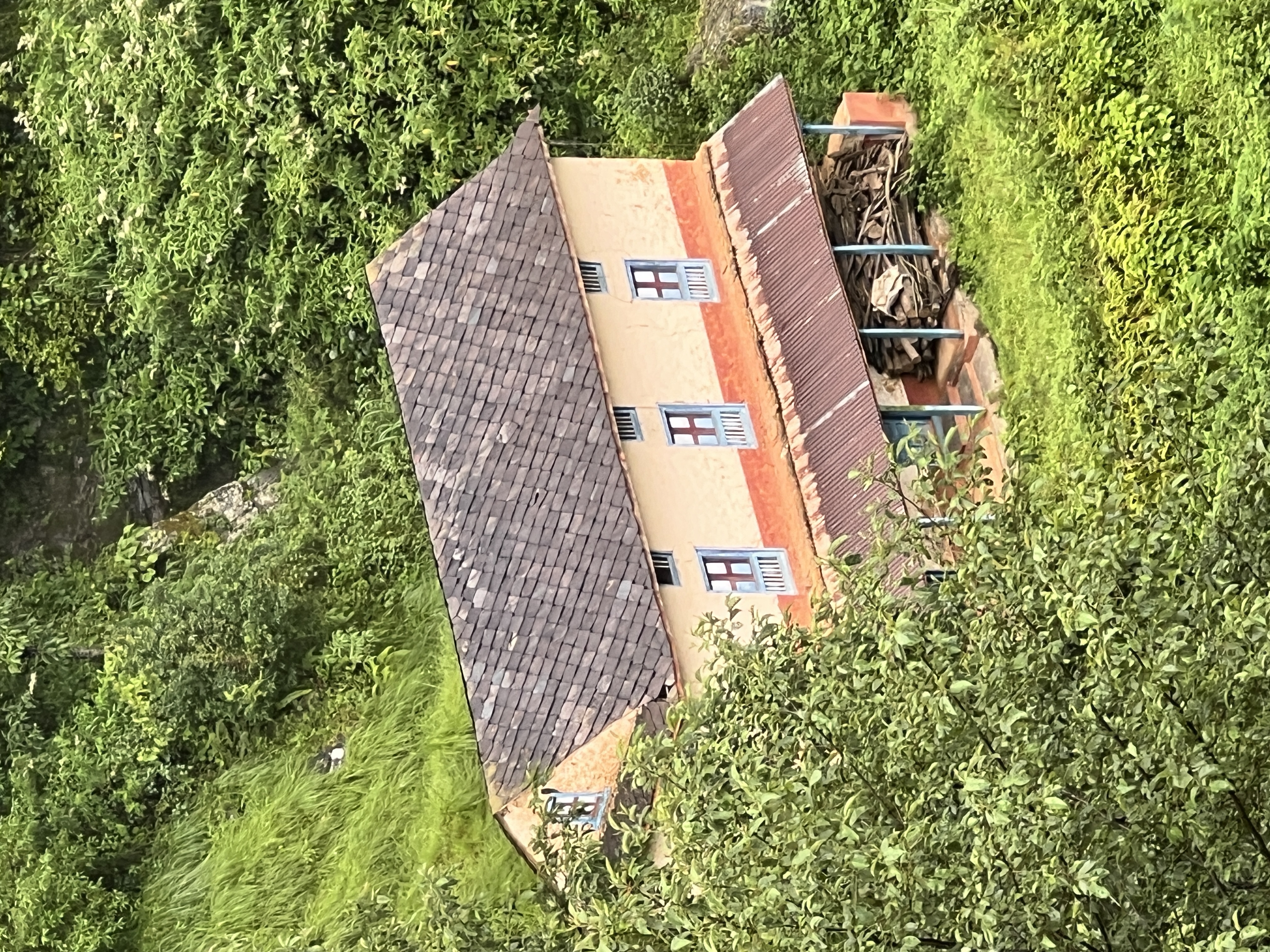
Fish-skin shaped stone slates "machha katle"roof.
Yet, they tell a story of adaptation. Here and there, modern
artifacts slip in—tin roofs made by flattening and reusing bitumen tanks left
behind by road pavement projects.
On the trail, the first house that stole my gaze featured a
breathtaking Machha-Katle (fish-skin) design, its stone slates
meticulously layered like scales. Others bore kiln-fired clay tiles likely
birthed in the old kilns of Panauti or Gwarko, while the rest wore the
ubiquitous, weathered corrugated iron sheets (CGI). Standing before these
structures—many built 50, 60, or 70 years ago—I realized they were silent
survivors of the devastating 2015 earthquake. A few lay derelicts or crumbled
by time and abandonment, but the majority stood proud.
To an architect’s eye, these homes follow an unwritten,
generational building code dictated by an agrarian lifestyle:
- The
Ground Floor: The heart of the home, dedicated to the kitchen and
dining. The interior remains dimly lit, shaded by the deep overhang of the
porch—the Pindi. The Pindi serves as the true living room, a
transitional space between the private home and the public world.
- The
First Floor: Reached by a worn wooden staircase, this level is
reserved for bedrooms and quiet family gatherings.
- The
Attic: A dedicated, dry storage space under the eaves.
The placement of windows follows a strict, respectful
discipline: they face the valley, opening up to light and wind, never
punctuated blindly against the hillside. The attic features tiny rows of
windows to keep the harvest dry; the middle floor boasts the largest windows
for comfort; and the roof is always pitched—an absolute necessity to shed the
violent monsoon downpours and protect the mud-and-stone walls from seepage.
Chapter IV: The Spaces of Connection
Beyond the walls lies the Angan—the courtyard. It is
arguably the most versatile architectural space in rural Nepal.

Photo 5:
Red mud plastered house, versatality of yard "Angan".
The Angan is a theater of daily life. It is where the
chicken pen is watched, where grains are spread to catch the sun, where bamboo
baskets are woven, and where the autumn harvest is winnowed. It is a playground
for children, and, when the time comes, it transforms into a venue for
weddings, feasts, and community life.
Flanking this space is the Goth or Khor, the
dedicated shelter for cows, goats, and water buffaloes. Further away stands the
outhouse. In alignment with ancient hygiene sensibilities, the toilet is never
attached to the main structure; it remains a simple pit-latrine with a flat
pan, kept at a distance. Here, water is a paradox—abundant and destructive
during the monsoon floods, yet heartbreakingly scarce in the dry months of
March and April, making piped water the ultimate dream and political promise
for these hills.
Chapter V: The Village is Alive
For years, a heavy assumption weighed on my mind—a fear that
Nepal's mid-hills were rapidly turning into ghost towns, drained of life by
migration, mirroring the tragic abandonment seen in so many mountainous regions
across the globe.
Today, that assumption was beautifully shattered.

Photo 6:
Prayer flags hung high up and compost fertilizer making in the process right
next to corral "goth"..
The villages stretching between Lakhuri Bhanjyang and Mane
Dobhan are deeply, vibrantly alive. The houses are meticulously kept. Windows
were thrown open to catch the post-rain breeze. I watched, with a swelling
heart, as women dried clothes in the Angan after the morning downpour,
and stepped into the fields to harvest fodder for their cattle. The cycle of
subsistence farming—the timeless dance of corn and millet—continues
uninterrupted.
From one house below the trail, the loud, booming rhythm of
a Hindi song echoed through the valley. High above another, Lungta
prayer flags snapped violently in the wind, sounding like a pack of galloping
horses. These homes are not abandoned shells; they are occupied by the souls
who belong to them, predominantly the Tamang community, guarding their
ancestral soil.
Epilogue: The Lens of Remembrance
This day hike, captured spontaneously through the lens of my
smartphone camera, became something far deeper than exercise. It was a
pilgrimage.
To the Nepali diaspora living across distant oceans,
dreaming of the terraced hills and the smell of wet mud: know that the heart
of the motherland still beats. The village life you miss—the vibrant,
ongoing, deeply spiritual connection between human shelter and the mountain
earth—is not a memory. It is alive. It is waiting. And it is just as beautiful
as you remember.